

Venedig – Cannaregio
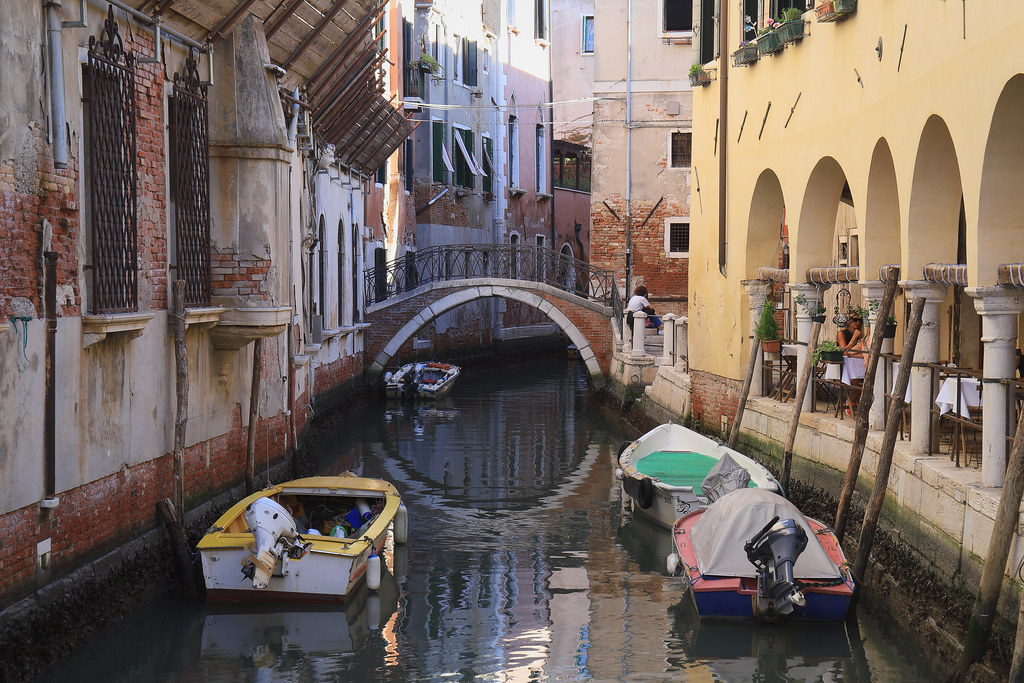
Rio della Maddalena
Cannaregio (Italian pronunciation: [kannaˈredʒo]) is the northernmost of the six historic sestieri (districts) of Venice. It is the second largest sestiere by land area and the largest by population, with 13,169 people as of 2007.
Isola di San Michele, the historic cemetery island, is associated with the district.
History
The Cannaregio Canal, which was the main route into the city until the construction of a railway link to the mainland, gave the district its name (Canal Regio is Italian for Royal Canal). Development began in the eleventh century as the area was drained and parallel canals were dredged. Although elegant palazzos were built facing the Grand Canal, the area grew primarily with working class housing and manufacturing. Beginning in 1516, Jews were restricted to living in the Venetian Ghetto. It was enclosed by guarded gates and no one was allowed to leave from sunset to dawn. However, Jews held successful positions in the city such as merchants, physicians, money lenders, and other trades. Restrictions on daily Jewish life continued for more than 270 years, until Napoleon Bonaparte conquered the Venetian Republic in 1797. He removed the gates and gave all residents the freedom to live where they chose.
In the 19th century, civil engineers built a street named Strada Nuova through Cannaregio, and a railway bridge and road bridge were constructed to connect Venice directly to Mestre. Today, the areas of the district along the Grand Canal from the train station to the Rialto Bridge are packed with tourists, but the rest of Cannaregio is residential and relatively peaceful, with morning markets, neighborhood shops, and small cafés.
(Wikipedia)
The Chiesa dei Santi Apostoli di Cristo (Church of the Holy Apostles of Christ), commonly called San Apostoli, is a 7th-century Roman Catholic church located in the Cannaregio sestiere of the Italian city of Venice. It is one of the oldest churches in the city and has undergone numerous changes since its foundation. The present building is the result of a major reconstruction project which was undertaken in 1575. The church is notable particularly for the Cornaro Chapel, an important example of Early Renaissance architecture, added by Mauro Codussi during the 1490s. The chapel is the burial place of several members of the powerful Cornaro family (Venetian: Corner), including Catherine Cornaro, Queen of Cyprus and Armenia. The church houses several works of art including pieces by Giambattista Tiepolo and Paolo Veronese.
History
In the 7th century Venice was not yet a city, but a collection of small communities scattered throughout the lagoon. St Magnus (Italian: San Magno), the Bishop of Oderzo, came to the lagoon and founded eight churches.[1] According to a legend recounted by the historian Flaminio Cornaro, St Magnus had a vision of the Twelve Apostles who commanded him to build a church on a site where he saw twelve cranes. This location, eventually to be in the sestiere of Cannaregio, became the site of the church of San Apostoli. The church stands on the Campo dei Santi Apostoli at the beginning of the Strada Nuova (New Road).
During the 1490s the Cappella Cornaro, built as a burial place for the wealthy Venetian Cornaro family, was added to the church. It is considered one of the most important Early Renaissance chapels in Venice.[note 1] It is unknown exactly who designed the chapel, although it is most often attributed to the architect Mauro Codussi. At the same time a porch was added to the front of the church and a sacristy was built. These alterations were also overseen by Codussi.
In the middle of the 16th century the church briefly housed the Catecumeni, a Venetian fraternity for those wishing to convert to Christianity, before they established a permanent home at San Gregorio in 1571. Shortly after this, in 1575, the church was completely rebuilt. Only parts of the earlier structure were retained, including some frescos and the Cornaro Chapel.
During the early 18th century, Andrea Tirali added detailing, including the onion dome, to the campanile which itself had been a late 17th-century addition.
Interior
The church retains its 16th century layout: a single nave supported by two rows of columns. One chapel has the funeral monument of Count Giuseppe Mangilli, designed by Luigi Trezza with bust by Angelo Pizzi. The main altarpiece is a Custodian Angel by Bernardo Strozzi.
Cornaro Chapel
The chapel is the burial place of several members of the Cornaro family, including Giorgio Cornaro and his sister Catherine Cornaro the Queen of Cyprus (since removed to the church of San Salvadore elsewhere in Venice), The charitable organisation Save Venice funded the restoration of the chapel, including the relief carvings. The main altar of this chapel was the Last Communion of St Lucy (1747–48) by Tiepolo.
(Wikipedia)
Cannaregio ist der am dichtesten besiedelte Stadtteil (Sestiere von Venedig) Venedigs. Die 13.169 Einwohner (Stand 12. Dezember 2007) des Sestiere verteilen sich auf die Pfarren San Giobbe e Bernardino (mit Opera Pia Contarini), San Marcuola (mit Santa Fosca), Madonna dell’Orto (mit San Marziale, Ospedale Fatebenefratelli und Casa Card. Piazza), Sant’Alvise (mit San Bonaventura (Carmelitane) und Canossiane), San Girolamo (mit Santa Maria Madre del Redentore und Ist. Suore Dorotee), San Felice (mit Santa Sofia), Santi Apostoli (mit Gesuiti) und San Canciano (mit San Giovanni Crisostomo und Santa Maria dei Miracoli). Die Flächenausdehnung beträgt 150 Hektar.
Cannaregio liegt im Nordwesten von Venedig und wird von der flächenmäßigen Ausdehnung nur noch von Castello übertroffen. Der Name leitet sich angeblich vom Zustand des Sestiere ab, den es vor der Besiedlung hatte, als es sich noch um ein versumpftes Gebiet handelte, in dem Schilfrohr (italienisch canna: Schilf) wuchs.
Gliederung
In Cannaregio beginnt der Canal Grande, von den Venezianern „Canalazzo“ genannt, der sich in Form eines umgekehrten „S“ nach San Marco windet. Ursprünglich war die dem Festland zugewandte Öffnung des Canal Grande nicht der Haupteinfahrtsweg. Diese Funktion erfüllte der Cannaregiokanal, der nach der Ponte delle Guglie beim Palazzo Labia in den Canal Grande mündet.
In Cannaregio wohnen überwiegend Arbeiter und Angestellte, viele kleine Gewerbebetriebe sind dort angesiedelt. Schlagader des Bezirks ist die Trasse der Strada Nova, die sich von der Ponte delle Guglie, zu Beginn noch Rio terrà San Leonardo, danach Rio terrà della Maddalena und kurz noch Via V. Emanuele benannt, bis zum Campo SS. Apostoli hinzieht. Von der Strada Nova Richtung Bahnhof, nur vom Campo San Geremia unterbrochen, kommt man in die Rio terrà Lista di Spagna. In dieser Straße finden sich entlang der Hausfassaden in den Straßenbelag eingelassene weiße Marmorstreifen. Hinter diesen Streifen war exterritoriales Gebiet, waren hier doch viele ausländische Botschaften untergebracht. Der Begriff „Rio terrà“ leitet sich vom Umstand ab, dass diese Straßen ursprünglich Kanäle waren, die man zugeschüttet (interrare: zuschütten) und dadurch begehbare Wege geschaffen hat.
(Wikipedia)