

The Postcard
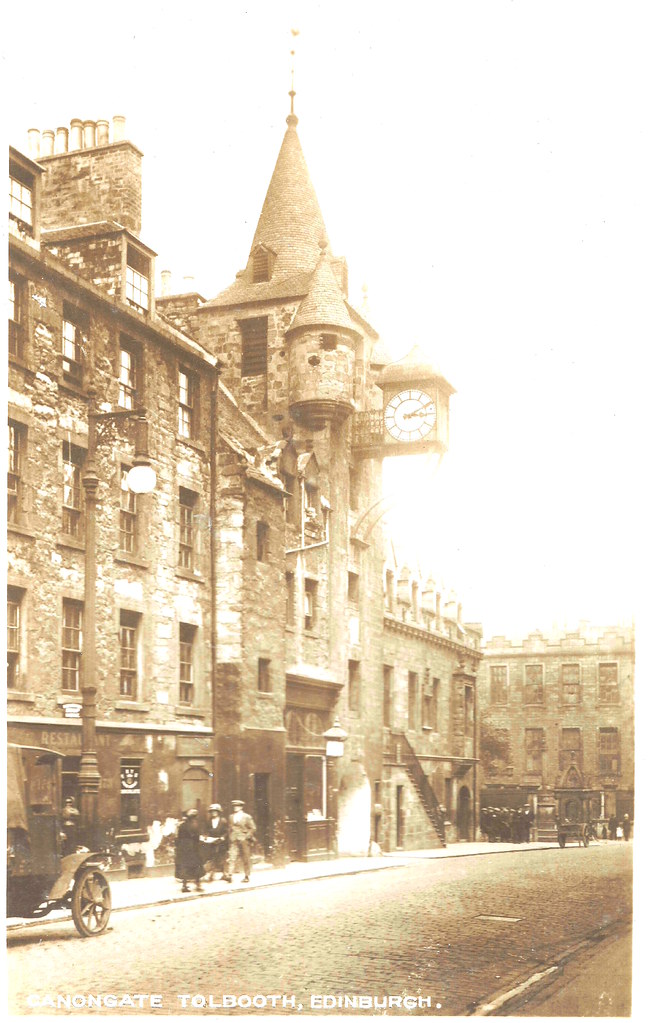
A postcard bearing no publisher’s name that features a glossy real photograph. The card was posted in Glasgow using a 1½d. stamp on Monday the 28th. October 1929. It was sent to:
Monsieur F. Guincham,
VI Esterhazy 18,
Vienna,
Austria.
The message on the divided back of the card was as follows:
“Mes salutations
sincères.
D.F.
28. X. 29″
Canongate
Canongate is the historic eastern section of Edinburgh’s Royal Mile, functioning as a separate burgh from the 12th. century until the 1850’s. It runs from St Mary’s Street to the Palace of Holyroodhouse.
Origin: The name stems from the “canons’ gait” (road) used by the canons of Holyrood Abbey.
Independent Town: Historically a separate burgh, it was considered a more fashionable area than Edinburgh in the 17th. century.
Key Landmarks:
— Canongate Tolbooth (1591): Formerly the center of administration and justice, it now houses The People’s Story Museum.
— Canongate Kirk (1691): The parish church, located on the Royal Mile.
— Canongate Kirkyard: Final resting place for notable figures such as economist Adam Smith and poet Robert Fergusson.
— The Royal Mile: It forms the lower, eastern portion of this famous thoroughfare.
— Architecture: Known for narrow “closes” and renovated 19th.-century tenements.
Modern Day: The area is a vibrant part of the Old Town, leading to the Scottish Parliament and Holyrood Palace.
A Dow Jones Fall
So what else happened on the day that the card was posted?
Well, on the 28th. October 1929, the Dow Jones Industrial Average dropped another 13% as confidence plunged.
This was the biggest single-day fall in the history of the Dow Jones, and remained so until the Black Monday of 1987.
Black Monday occurred on the 19th. October 1987, when global stock markets experienced a severe crash, with the Dow Jones Industrial Average dropping 508 points, or 22.6% in a single day.
It remains the largest one-day percentage decline in stock market history, triggering a worldwide downturn.
Bernhard von Bülow
The 28th. October 1929 was also not a good day for Bernhard von Bülow, because he died in Rome at the age of 80 on that day.
Bernhard von Bülow was Chancellor of Germany from 1900 to 1909.
— Scandal Associated With Bernhard von Bülow
In 1907, during the Harden–Eulenburg Affair, Adolf Brand, the founding editor of the homosexual periodical Der Eigene, printed a pamphlet.
This alleged that Bülow had been blackmailed for engaging in homosexual practices, and was therefore morally obligated to oppose Paragraph 175 of the German penal code, which outlawed homosexuality.
Sued for slander and brought to trial on the 7th. November 1907, Brand asserted that Bülow had embraced and kissed his private secretary, Privy Councilor Max Scheefer, at all-male gatherings hosted by Eulenburg.
Testifying in his own defense, Bülow denied the accusation, but remarked that he had heard unsavoury rumours about Eulenburg.
Taking the stand, Eulenburg defended himself against Brand’s charge by denying that he had ever held such events, and claimed that he had never engaged in same-sex acts, which subsequently led to a perjury trial.
Despite concluding testimony by the chief of the Berlin police that Bülow may have been the victim of a homosexual blackmailer, he easily prevailed in court, and Brand was sent to prison.